

Quick answer: Mosquito season in Tampa Bay runs from roughly March through November, with peak pressure from June through September. Hillsborough County’s combination of afternoon thunderstorms, coastal wetlands, and warm temperatures creates some of the most intense mosquito conditions in Florida. Barrier treatments, source reduction, and professional mosquito control from a licensed provider are the most reliable ways to protect your Tampa, Brandon, or Clearwater yard.
Tampa Bay residents know the drill. You step outside for an evening on the patio, and within minutes you are heading back inside. Hillsborough County’s climate (warm winters, high humidity, and a rainy season that dumps inches of water in a matter of hours) keeps mosquito populations active for most of the year. If you live in Brandon, Riverview, Wesley Chapel, or Clearwater, the pressure is just as intense, and in some neighborhoods, even worse.
This guide covers when mosquito season runs in the Tampa Bay area, what makes Hillsborough County such a productive breeding environment, and what you can do to reduce mosquito pressure on your property. Whether you are looking for practical prevention tips or considering professional mosquito control in Tampa, you will find the information you need to make a confident decision.
The Short Answer: Tampa Bay’s Mosquito Season Is Long
Tampa’s mosquito season does not behave like a brief summer nuisance. Mosquitoes become active here as early as late February or early March, once daytime temperatures consistently exceed 50°F. Populations climb through spring, then spike sharply when Tampa Bay’s rainy season begins in June. Activity remains high through October and often lingers into November before cooler weather finally slows breeding.
Brandon and Riverview follow the same pattern. Clearwater and coastal communities along Tampa Bay can see slightly extended pressure due to the proximity of saltwater wetlands and tidal areas that support species capable of breeding in brackish water. Across the region, the expectation should be seven to nine months of meaningful mosquito activity each year.
According to the University of Florida IFAS Extension, Florida is home to 80 mosquito species, more than almost any other state. Several of those species are common across Hillsborough County and thrive under the exact conditions Tampa Bay experiences throughout its long warm season.
Tampa Mosquito Season, Month by Month
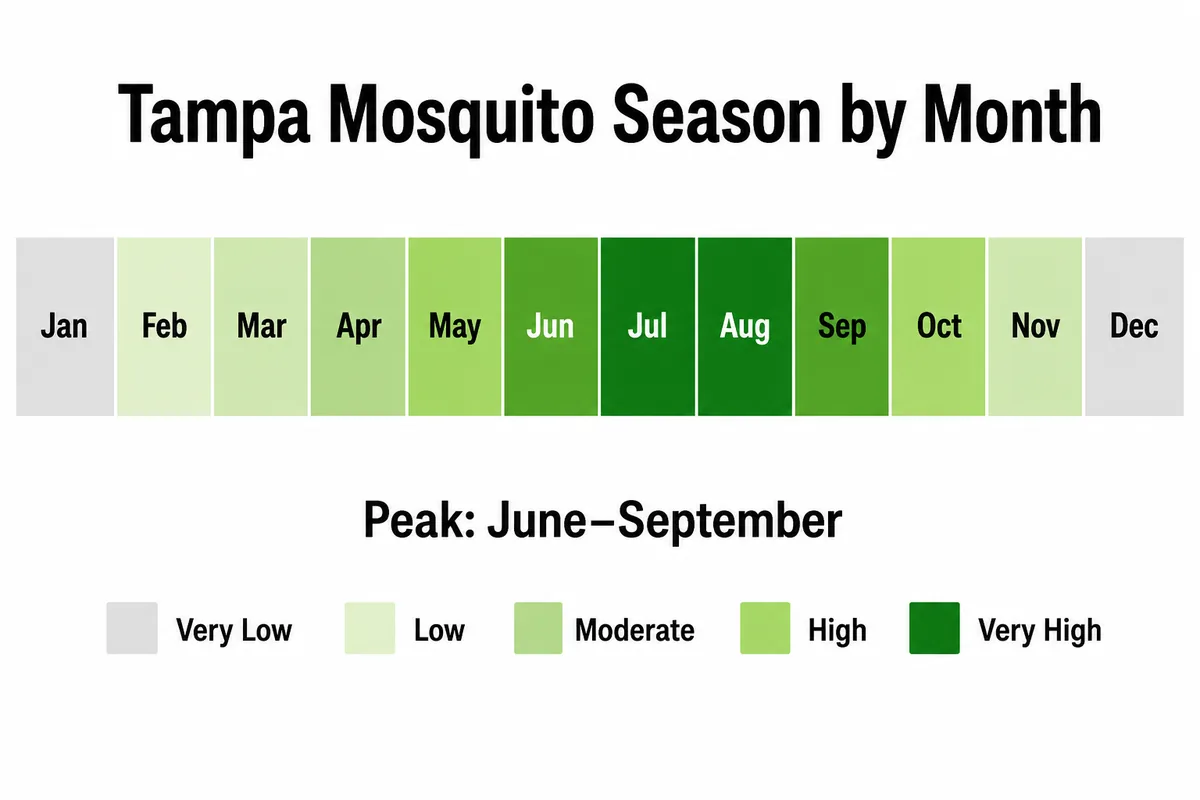
Knowing when mosquito pressure peaks helps you time prevention efforts more effectively. The table below reflects typical conditions across Tampa, Brandon, Riverview, and Clearwater.
| Month | Mosquito Activity Level | Notes |
|---|---|---|
| January | Very Low | Cold fronts suppress most activity |
| February | Low | Warming trend begins; isolated activity possible |
| March | Low to Moderate | Season begins; early breeders emerge |
| April | Moderate | Populations build; outdoor protection recommended |
| May | Moderate to High | Pre-rainy season surge; humidity climbs |
| June | High | Rainy season begins; populations spike sharply |
| July | Very High | Peak month; standing water abundant after daily storms |
| August | Very High | Sustained peak; evening pressure intense across Tampa Bay |
| September | High | Activity strong; storm activity continues |
| October | Moderate to High | Populations begin to taper; still problematic on warm days |
| November | Low to Moderate | Cool fronts slow activity; active on warm afternoons |
| December | Very Low | Season effectively ends; dormancy sets in |
The June through September window is when most Tampa-area homeowners feel the problem most acutely. Tampa’s afternoon thunderstorm pattern, with storms that roll in nearly every day during peak season, creates fresh standing water continuously, shortening the mosquito breeding cycle and accelerating population growth. For more detail on how Florida’s season winds down in the fall, see McCall’s guide on when mosquito season ends in Florida.
Why Mosquitoes Thrive in Tampa Bay
Tampa Bay is not simply warm and wet. The region’s geography and land use patterns combine to create mosquito breeding conditions that persist throughout the warm season. Several factors work together to make Tampa-area mosquito pressure consistently high.
Coastal wetlands and tidal areas extend breeding habitat. Tampa Bay’s shoreline is bordered by mangrove forests, tidal flats, and coastal marshes that serve as productive year-round breeding habitat. Species like the salt marsh mosquito thrive in these areas and can travel significant distances from their breeding sites into residential neighborhoods in Tampa, Clearwater, and surrounding communities.
Afternoon thunderstorms continuously refresh breeding sites. Tampa receives an average of 46 inches of rain per year, with the majority falling between June and September. Each significant storm event fills gutters, low spots in yards, landscaping features, and forgotten containers across Hillsborough County. Mosquitoes require as little as half an inch of standing water to complete their breeding cycle, and Tampa’s daily summer storms provide that supply reliably.
Rapid urban growth creates new habitat. Brandon, Riverview, Wesley Chapel, and Plant City have all expanded significantly over the past decade. New construction disturbs soil drainage patterns, creates low-lying areas, and introduces temporary water accumulation that becomes breeding habitat before landscaping is fully established.
“What drives the worst mosquito pressure in Tampa and Brandon is really the combination of storm frequency and how dense the residential landscaping has gotten,” says a McCall Tampa Service Center Manager. “When you have mature trees, dense shrubs, and a yard that holds water after a storm, you have everything a mosquito needs (shade, moisture, and resting cover) within a few hundred square feet.”
How to Reduce Mosquitoes in Your Tampa Yard
Reducing mosquito pressure starts with the breeding sites on your own property. No professional spray treatment will deliver lasting results if active breeding sources remain untouched. Source reduction is the foundation of any effective mosquito control program in Tampa.
Audit your yard for standing water at least once per week. During Tampa’s rainy season, a weekly walk-through is essential. Look for water collecting in:
- Flower pots and saucers
- Bird baths
- Clogged gutters and downspout extensions
- Tarps, pool covers, and tire swings
- Children’s outdoor toys
- Low spots or depressions in the lawn
- Gate post caps and hollow fence posts
Empty, flip, or refresh any container holding water. A single neglected flower pot saucer can produce hundreds of adult mosquitoes.
Clear gutters and check downspouts. Clogged gutters are among the most common mosquito breeding sites found on Tampa-area residential properties. After heavy rain, a gutter full of debris holds water for days, long enough to complete multiple breeding cycles during peak season.
Trim vegetation and maintain grass height. Adult mosquitoes rest in dense, shaded vegetation during the heat of the day. Overgrown shrubs, unmaintained borders, and tall grass provide resting cover close to outdoor living areas. Keeping vegetation trimmed reduces where mosquitoes can shelter between feeding events.
Address persistent drainage problems. Low areas that collect water after every storm are consistent mosquito producers. Regrading problem spots or installing French drains can substantially reduce breeding habitat over time. This is particularly relevant in Brandon and Riverview, where newer subdivisions sometimes have grading issues that only become apparent after heavy rain.
“The most common breeding source we find on Tampa-area properties is not a pond or a ditch: it is something small that the homeowner walks past every day without thinking about it,” says a McCall Tampa Service Center Manager. “A planter that drains into a tray, a section of low fence line that pools water, a forgotten bucket tucked under a deck. Those containers can produce hundreds of mosquitoes per week and completely undermine what a barrier treatment accomplishes.”
Natural and Repellent Options
Some Tampa homeowners prefer to start with natural or lower-chemical approaches, particularly for smaller outdoor spaces or households with sensitivities to certain products. These options provide a meaningful layer of protection when used correctly, though they work best as supplements to a broader control plan.
EPA-registered repellents containing DEET, picaridin, or oil of lemon eucalyptus remain the most effective personal protection options available. The CDC endorses all three for protection against mosquito species capable of transmitting disease. For a detailed look at natural repellent alternatives, see McCall’s guide on effective methods of natural mosquito repellent.
Mosquito dunks and Bti larvicide tablets are practical for standing water that cannot be drained, such as ornamental ponds, rain barrels, and certain drainage features. These products use Bacillus thuringiensis israelensis (Bti), a naturally occurring bacterium that kills mosquito larvae without harming birds, fish, pets, or beneficial insects.
Outdoor fans on screened porches and covered patios can improve comfort meaningfully. Mosquitoes are weak fliers, and consistent airflow disrupts their ability to navigate toward a target. Fans work best in enclosed or semi-enclosed outdoor spaces where airflow can be concentrated.
Bat houses and purple martin nesting boxes attract natural mosquito predators. The impact on overall mosquito pressure is modest and variable, but these additions can contribute to an integrated yard management approach over time.
Natural and repellent options reduce exposure and help manage lower-level pressure. For Tampa Bay’s peak season conditions, particularly in areas near wetlands, retention ponds, or with recurring drainage issues, professional mosquito control in Tampa provides the sustained, consistent results that these options alone cannot match.
Professional Mosquito Control in Tampa
When seasonal pressure, yard conditions, or proximity to water features make self-management difficult to sustain, professional mosquito control delivers a structured, science-based solution. McCall Pest & Wildlife’s mosquito control program targets mosquitoes at multiple life stages, addressing adult populations through barrier treatments and breeding populations through larvicide applications to standing water.
A professional mosquito control plan from McCall includes:
Property inspection. A trained McCall technician evaluates your yard for active breeding sites, adult resting areas, and the specific environmental conditions driving mosquito pressure on your property. This step is especially important for Tampa-area homes near retention ponds, wooded lots, or properties with significant landscaping features.
Barrier spray treatment. Adulticide is applied to vegetation, fence lines, and shaded resting areas around your property. Barrier treatments target adult mosquitoes where they rest during daylight hours. Most treatments remain effective for approximately 21 to 30 days under normal conditions, though Tampa’s heavy summer rainfall can reduce residual activity and may require more frequent service during peak season.
Larvicide source treatment. Standing water features that cannot be drained, such as retention ponds, decorative water features, and drainage swales, can be treated with EPA-registered larvicides that prevent mosquito larvae from developing into biting adults.
Recurring service. A single treatment cannot control mosquito pressure through Tampa’s long season. Recurring monthly service provides sustained protection from spring through fall. Each visit reinforces the previous application and addresses new conditions created by Tampa Bay’s ongoing rainfall and landscape changes.
McCall’s Tampa pest control team serves Hillsborough County and surrounding communities. Our local technicians understand the specific breeding conditions, storm patterns, and seasonal timing that define mosquito pressure in this region. For neighboring metro areas, see McCall’s mosquito control guides for Jacksonville, Orlando, and Ocala.
Areas We Serve Around Tampa
McCall Pest & Wildlife provides mosquito control service throughout the Tampa Bay area and Hillsborough County. Our local Tampa team regularly serves:
- Tampa, residential neighborhoods, waterfront properties, and areas near Hillsborough Bay and the Tampa Bay shoreline
- Brandon, suburban neighborhoods with retention ponds, wooded lots, and properties affected by post-storm drainage issues
- Riverview, newer subdivisions and established neighborhoods with persistent standing water and proximity to the Little Manatee River corridor
- Clearwater, coastal properties, tidal-adjacent neighborhoods, and communities near Old Tampa Bay
- Wesley Chapel, rapidly developing areas with grading and drainage conditions that create breeding habitat during rainy season
- Plant City, agricultural and semi-rural properties throughout eastern Hillsborough County
If you are unsure whether your address falls within our service area, contact your local McCall Tampa team for a quick confirmation and a free quote.
Frequently Asked Questions
When is mosquito season in Tampa?
Mosquito season in Tampa typically runs from March through November. Activity builds in early spring as temperatures warm and peaks during the summer rainy season, which runs from June through September. October and November can still see meaningful mosquito pressure during warm stretches, though populations decline as cooler fronts arrive. Tampa Bay’s mild winters mean the season is substantially longer than what residents in northern states experience.
Why are mosquitoes so bad in Tampa Bay?
Tampa Bay’s mosquito pressure results from several overlapping conditions. Coastal wetlands, tidal marshes, and the bay shoreline provide extensive year-round breeding habitat. Tampa’s summer thunderstorm pattern (frequent, heavy afternoon storms from June through September) continuously replenishes standing water across Hillsborough County, giving mosquitoes a constant supply of fresh breeding sites. High humidity and consistently warm temperatures shorten the breeding cycle, allowing populations to rebuild quickly after each rain event.
How do I keep mosquitoes out of my Tampa yard?
The most effective approach combines weekly source reduction with professional barrier treatment. Start by identifying and eliminating standing water on your property: in gutters, flower pots, bird baths, tarps, and low spots in the lawn. Trim dense vegetation to reduce adult resting cover. For sustained protection through Tampa’s long season, a professional mosquito control program from McCall applies recurring barrier treatments and larvicide applications that keep populations from rebounding after every storm.
Is professional mosquito control worth it in Tampa?
For most Tampa-area homeowners, yes. Hillsborough County’s long season, proximity to coastal wetlands, and daily summer storm activity make self-management difficult to sustain over seven to nine months. Professional service from McCall includes thorough property inspection, larvicide treatment of breeding sources, barrier spray applied by trained technicians, and recurring visits timed to maintain protection throughout the season. For properties near retention ponds, wooded lots, or with persistent drainage issues, professional treatment delivers results that over-the-counter products reliably cannot.
Protect Your Tampa Yard Before Peak Season Hits
Tampa Bay’s mosquito season is long, predictable, and intense. The combination of warm winters, a sustained summer rainy season, and Hillsborough County’s natural landscape means that waiting until July to address the problem puts you well behind the pressure curve.
McCall Pest & Wildlife’s local Tampa team is ready to assess your property and build a mosquito control plan tailored to your yard, your neighborhood, and your season.
- See McCall’s mosquito control program and learn what a season-long plan looks like for your yard.
- Explore McCall pest control in Tampa.
- Contact McCall for a free Tampa mosquito quote and schedule a property assessment tailored to your yard.