
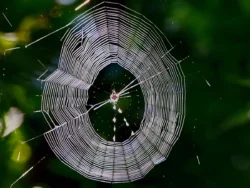
Florida is one of the most spider-rich states in the country. The combination of year-round warmth, high humidity, and abundant insect populations creates ideal habitat for dozens of spider species — most of them completely harmless, a small number genuinely concerning, and many that Florida homeowners see regularly without ever knowing what they’re looking at.
This guide covers the 9 most common spiders in Florida: what they look like, where they live, whether they pose any real risk, and how to tell them apart. We’ve structured this as a practical identification resource — the kind you can return to when you find something in your garage, your shed, or your back porch and want a straight answer about what it is and what to do about it.
Quick Reference: Dangerous vs. Harmless Florida Spiders
| Spider | Venom Risk | Found Indoors? | Key Identifier |
|---|---|---|---|
| Black Widow | ⚠️ Dangerous | Mostly outdoors / garages | Shiny black; red hourglass on underside |
| Brown Widow | ⚠️ Caution | Outdoor structures, furniture | Brown/tan; orange hourglass; spiky egg sacs |
| Brown Recluse | ⚠️ Rare in FL | Rarely confirmed in Florida | Violin marking on back; 6 eyes (not 8) |
| Wolf Spider | ✅ Harmless | Yes — common | Large, fast, hairy; eye-shine at night |
| Southern House Spider | ✅ Harmless | Yes — very common | Brown; messy cobweb-style web in corners |
| Golden Silk Orb-Weaver | ✅ Harmless | Outdoor gardens and trees | Bright yellow/orange; large golden web |
| Spiny-Backed Orb Weaver | ✅ Harmless | Outdoor shrubs and porches | White/red/yellow; spiny projections on abdomen |
| Jumping Spider | ✅ Harmless | Yes — common indoors | Small; compact; large front-facing eyes |
| Cellar Spider | ✅ Harmless | Yes — very common | Long thin legs; small body; vibrates when disturbed |
The 9 Most Common Spiders in Florida
1. Black Widow Spider (Latrodectus mactans)
The most venomous spider in North America — and the one Florida homeowners most need to recognize.
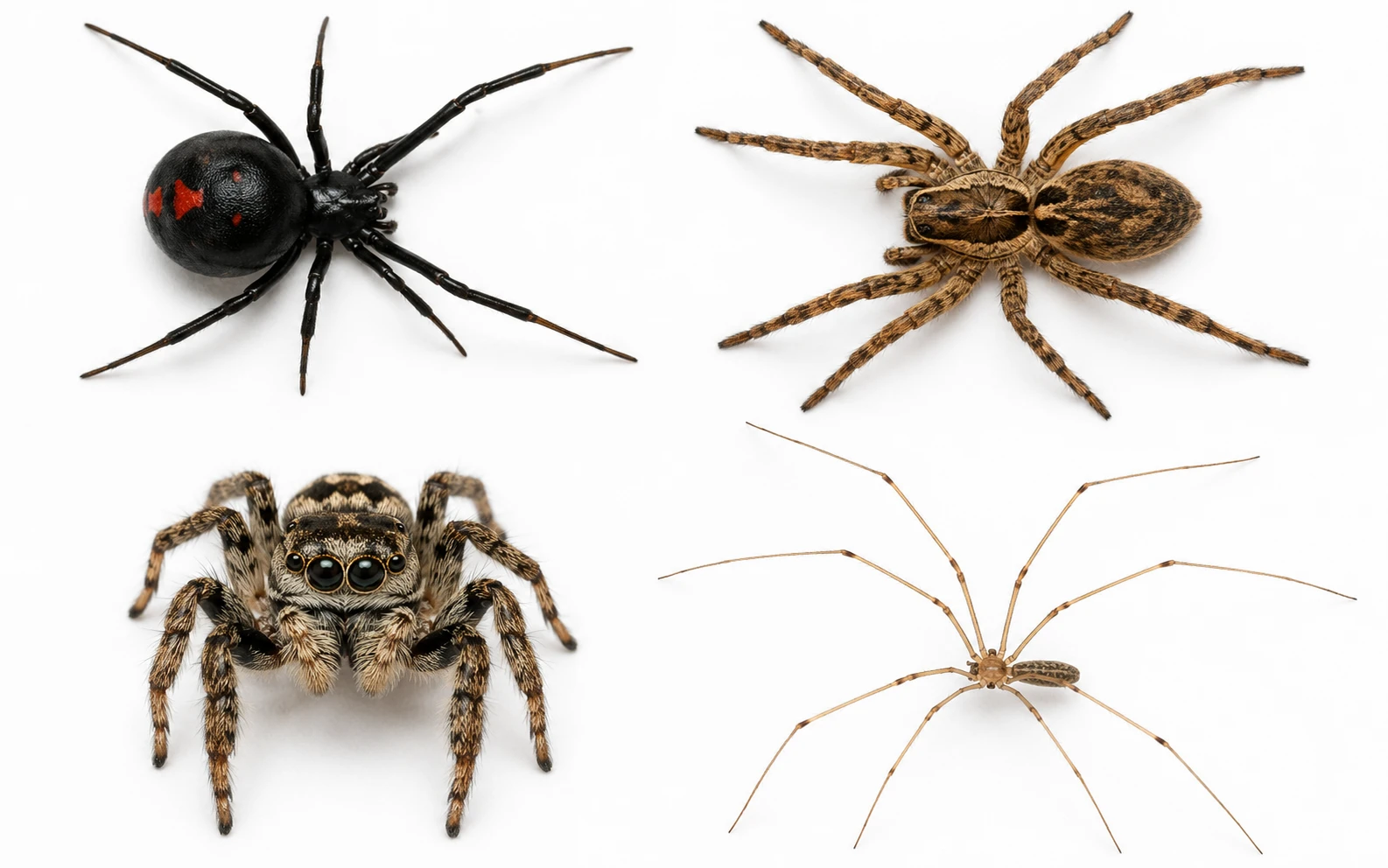
Black widows are medium-sized spiders (body roughly ½ inch; leg span up to 1½ inches) with a distinctive shiny black abdomen and a red hourglass marking on the underside. Only the females are medically significant — male black widows are smaller, less dramatic in appearance, and do not have medically relevant bites. The female is the spider to watch for.
Black widows in Florida are found most commonly in protected outdoor structures — garages, sheds, under outdoor furniture, inside utility boxes, in wood piles, and along the undersides of fence rails. They prefer dark, undisturbed spaces and build messy, irregular cobwebs close to the ground. Their webs feel noticeably tough and sticky compared to other spider webs.
A black widow bite causes significant pain, muscle cramping, sweating, and nausea. Bites require medical evaluation, particularly for children, elderly adults, and anyone with compromised health. If you identify a black widow in your home or property, do not handle it — contact pest control.
2. Brown Widow Spider (Latrodectus geometricus)
The brown widow is a close relative of the black widow and has become increasingly common in Florida over the past two decades, particularly in urban and suburban areas. It is tan to brown in color with an orange or yellow hourglass on the underside of the abdomen — lighter in color than the black widow’s red marking. Its egg sacs are distinctive: spiky, almost pom-pom-like in appearance, quite different from the smooth egg sacs of the black widow.
Brown widows are found in similar locations to black widows — under outdoor furniture, in rolled tarps, inside plastic outdoor containers, and in protected exterior areas. Their venom is considered less potent than the black widow’s, though bites still warrant medical attention. Because brown widows have expanded their Florida range significantly, they are now often encountered more frequently than the black widow in many parts of the state.
3. Brown Recluse Spider (Loxosceles reclusa)
Important Florida note: Despite their fearsome reputation, brown recluse spiders are not established in most of Florida. The Florida Department of Agriculture and Consumer Services has noted that confirmed brown recluse sightings in Florida are rare, and the vast majority of suspected brown recluse bites in the state are attributable to other species. If you think you’ve found a brown recluse in Florida, it is worth having it professionally identified before assuming that’s what it is.
The true brown recluse is light brown to tan with a characteristic dark, violin-shaped marking on the back of the cephalothorax (the body section with the legs). Critically, brown recluses have six eyes arranged in three pairs — unlike the eight eyes of most spiders. Body length is roughly ¼ to ½ inch. They build irregular, non-sticky webs in dark, undisturbed areas.
The concern with genuine brown recluse bites is the potential for necrotic skin reactions in some cases, though many bites cause only mild symptoms. If you have any reason to believe you’ve been bitten by a recluse, seek medical evaluation promptly.
4. Wolf Spider (Family Lycosidae)
Wolf spiders are one of the most commonly encountered large spiders in Florida homes — and among the most frequently misidentified as something dangerous. They are not.
Wolf spiders are large, robust, and fast-moving. Body length ranges from ½ to 1½ inches, with legs extending the apparent size significantly. They are brown to gray with dark markings, often in a striped or mottled pattern, and have a distinctly hairy appearance. Their most unusual feature: female wolf spiders carry their egg sac attached to the underside of the abdomen, and after hatching, the spiderlings ride on their mother’s back — something no other commonly encountered Florida spider does.
Wolf spiders are ground hunters that do not build webs. They pursue prey actively and move quickly when disturbed, which makes an unexpected indoor encounter startling. They are often found on garage floors, in ground-floor corners, along baseboards, and in rooms with exterior access. At night, a flashlight will reflect from their large eyes — a distinctive green or white eyeshine.
Wolf spider venom is not medically significant for healthy adults. They can bite if handled, but the effect is comparable to a bee sting and resolves without treatment. They are beneficial predators and, in outdoor contexts, are more useful than harmful.
5. Southern House Spider (Kukulcania hibernalis)
The southern house spider is one of the most common spiders found inside Florida homes — and one of the most frequently mistaken for a brown recluse, which it is not. Males and females look dramatically different from each other, which adds to the identification confusion.
Female southern house spiders are dark gray to brown, with a round abdomen and relatively small body (about ½ inch). They build flat, sheet-like webs in corners, around window frames, in ceiling angles, and in other undisturbed interior spaces. These webs have a tangled, slightly funnel-shaped structure and collect dust and debris over time.
Males are brown and slender with longer legs, and are the ones sometimes misidentified as brown recluses — but southern house spiders have eight eyes in two rows, not the six-eye arrangement of a true recluse. Southern house spiders are completely harmless.
6. Golden Silk Orb-Weaver (Trichonephila clavipes)
Known colloquially as the banana spider, the golden silk orb-weaver is one of Florida’s most visually impressive spiders — and it is entirely harmless. Females are large (body up to 1½ inches; leg span up to 3 inches) with a bright yellow to orange abdomen banded with dark markings, and silvery-gray on the cephalothorax. Males are small and brown, often barely noticeable sitting near a female’s web.
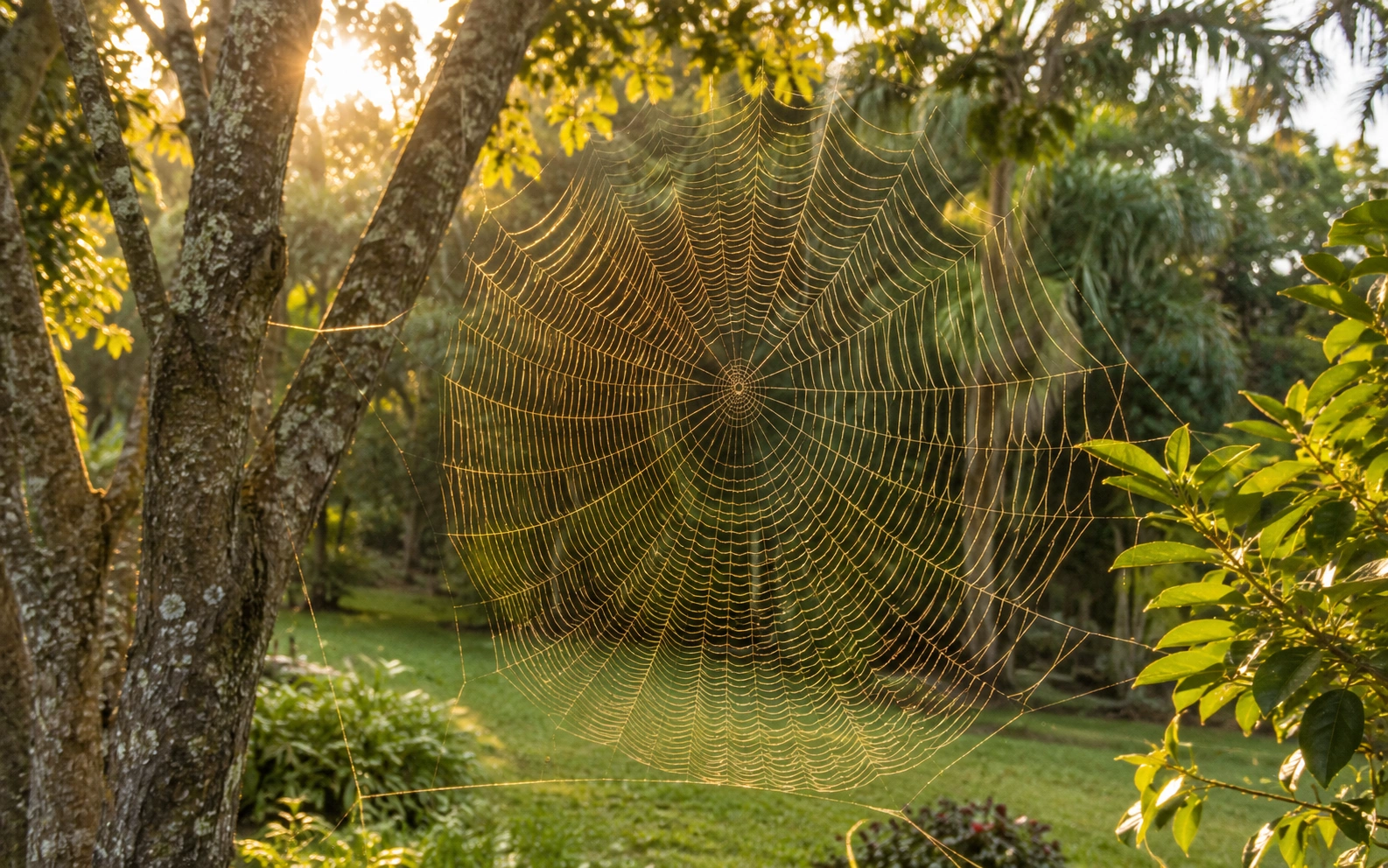
The defining feature is the web: large, circular, and woven from golden-colored silk that gives the species its name. These webs can reach 3 feet or more in diameter and are built between trees, along fence lines, and on the edges of wooded areas and garden borders. They are a frequent sight along Florida hiking trails and in yards with established trees.
The golden silk orb-weaver is beneficial — it captures and eats mosquitoes and other flying insects at a high rate. Despite their dramatic appearance, they are docile, not aggressive, and pose no real danger to humans. Their venom is not medically significant.
7. Spiny-Backed Orb Weaver (Gasteracantha cancriformis)
The spiny-backed orb weaver is unmistakable — a small spider (body about ½ inch wide) with a hard, crab-like abdomen covered in sharp, spine-like projections. Coloring varies: white, red, or yellow abdomen with black spots and red or black spines. The body is wider than it is long, giving it an almost geometric appearance.
Spiny-backed orb weavers build circular webs in shrubs, citrus trees, garden borders, and along the edges of wooded areas. They are extremely common in Florida landscapes and are a frequent surprise for homeowners doing yard work. They pose no danger to people — their venom is not medically significant and they are not aggressive. The spines are purely defensive and do not sting.
8. Jumping Spider (Family Salticidae)
Florida has numerous jumping spider species, and they are among the most commonly encountered spiders inside the home. Jumping spiders are small — typically ¼ to ½ inch — compact, and densely covered in hair. Their most distinctive feature is their eyes: two very large, forward-facing eyes that give them excellent binocular vision and a look that many people find almost endearing.
Unlike web-building spiders, jumping spiders are active daytime hunters. They stalk prey (including other small spiders) and leap to capture it — the leap can cover distances many times their body length. Indoors, they are found on walls, around window frames where insects congregate, on curtains, and near light sources. They move in short, precise bursts and often appear to watch you when approached.
Jumping spiders are completely harmless. They may attempt to bite if grabbed, but their bite is not medically significant. They are among the most visually interesting and behaviorally sophisticated of all common Florida spiders.
9. Cellar Spider (Family Pholcidae)
Cellar spiders are among the most commonly found spiders inside Florida homes. They are immediately recognizable by their extremely long, thin legs — often 4–5 times the length of their small, pale body — and their habit of hanging upside down in irregular webs in corners, closets, under stairs, and in garages.
When disturbed, cellar spiders vibrate rapidly in their web — a defensive behavior that makes them appear blurry and harder to target. They are sometimes called “daddy long-legs,” though this term is also used for harvestmen (a different, non-spider arachnid). True cellar spiders are entirely harmless.
A persistent rumor holds that cellar spiders are “the most venomous spider in the world but their fangs can’t penetrate human skin.” This is false on both counts. Cellar spider venom is not potent and their fangs, while small, are capable of piercing skin. The rumor has been thoroughly investigated and debunked — cellar spiders are harmless.
Signs You Have a Spider Problem — Not Just an Occasional Spider
Finding a spider indoors is almost always a solitary event, not a sign of infestation. Spiders are not social insects — they don’t nest in colonies the way ants or termites do. What looks like a spider “problem” is usually either a high-traffic entry point or an abundance of the insects spiders feed on.
Signs that warrant a closer look:
- Multiple widows found in and around the home. Finding more than one black or brown widow — especially near entry points, in the garage, or in the yard — indicates an established population. This warrants professional treatment.
- Webs accumulating faster than you can remove them. A single spider builds one web and stays there. Rapidly recurring webs across multiple areas of the home indicate multiple spiders, which indicates a sustained insect population feeding them.
- Spiders appearing consistently in the same indoor location. A spot that reliably produces spiders — a particular corner, behind a specific piece of furniture — is a location where insects are entering or congregating. The spider is following the food source.
- Egg sacs present in multiple locations. Egg sacs in several spots indicate active reproduction. For widow spiders specifically, multiple egg sacs warrant immediate professional attention.
How to Reduce Spider Activity in Your Florida Home
Because spiders follow insects, the most effective spider control strategy addresses the underlying insect population — not just the spiders themselves. Here’s what works in Florida:
- Reduce outdoor lighting near entry points. Insects are attracted to light, and spiders follow. Switching exterior lights near doors and windows to yellow or amber bulbs (which attract far fewer insects) significantly reduces the insect activity that draws spiders in.
- Seal entry points. Gaps around doors, windows, pipes, and conduit penetrations let insects — and spiders — inside. Weatherstripping, door sweeps, and caulked gaps reduce access points for both.
- Reduce clutter and undisturbed spaces. Spiders need undisturbed areas to build webs and hunt. Regular cleaning and decluttering of corners, closets, garages, and storage spaces removes spider habitat.
- Manage outdoor vegetation near the foundation. Dense vegetation against exterior walls creates insect habitat that feeds spider populations that eventually move inside.
- Address moisture issues. High indoor humidity and moisture attract the insects spiders prey on. Reducing moisture reduces the insect population, which reduces the spider population.
When to Call a Professional
Most spider encounters in Florida — including wolf spiders, jumping spiders, cellar spiders, and the various orb weavers — don’t warrant professional pest control. They are a manageable nuisance that responds to the prevention steps above.
Call a professional when:
- You’ve found widow spiders (black or brown) in or near your home — particularly if you find more than one or find egg sacs
- You’ve identified an entry point issue that’s producing spiders indoors consistently and you haven’t been able to locate or seal it
- Spider web accumulation is persistent across multiple areas despite regular cleaning
- You’re dealing with a broader insect problem that’s feeding spider activity and needs systematic treatment
At McCall, our spider service addresses both the spiders directly and the underlying conditions — entry points, insect populations, and exterior perimeter treatments — that support them. We serve Jacksonville, Gainesville, Ocala, Orlando, Tallahassee, Tampa, and surrounding Florida communities. If you find what you believe is a widow spider in or near your home, that’s a call we’d recommend making sooner rather than later.
Frequently Asked Questions About Florida Spiders
Which spiders in Florida are actually dangerous?
The only spiders in Florida with medically significant venom are the widow spiders — primarily the black widow and brown widow, both of which are present statewide. Brown recluse spiders are often blamed for bites in Florida but are not established in most of the state. All other spiders on this list are essentially harmless to healthy adults. The Florida Department of Agriculture and Consumer Services confirms widow spiders as the only native Florida spiders of medical concern.
Are brown recluse spiders common in Florida?
No. Despite their reputation, brown recluse spiders are not established in most of Florida. Confirmed sightings are uncommon, and many supposed brown recluse encounters in Florida are actually southern house spiders or other species. The vast majority of “recluse bites” reported in Florida cannot be confirmed as such. If you believe you’ve found a brown recluse in Florida, having it professionally identified is worth the effort before drawing conclusions.
What should I do if I find a black widow spider?
Do not handle it. Black widows are the most venomous spider in North America and a bite requires medical evaluation. If you find a black widow in your home or on your property — particularly in garages, sheds, under outdoor furniture, or in utility boxes — contact a pest control professional. Do not attempt to capture or remove it yourself. If you’re bitten, seek medical care promptly and, if possible, safely photograph or capture the spider for identification.
Why are there so many spiders in my Florida home?
Spiders follow their food source — insects. Florida’s warm, humid climate supports large insect populations year-round, which in turn supports large spider populations. If you have significant insect activity in or around your home (often driven by outdoor lighting, moisture issues, or structural entry gaps), you will have spiders. Reducing insect activity is the most effective long-term approach to reducing spider pressure.
Should I be concerned about wolf spiders in my home?
Wolf spiders look alarming because of their large size and speed, but they are not dangerous to healthy adults. Their venom is not medically significant, and bites — which require deliberate handling to provoke — produce localized pain comparable to a bee sting. Wolf spiders are solitary hunters, not colony pests. Finding the occasional wolf spider indoors is common in Florida and not a sign of infestation. Consistent indoor sightings may indicate high insect activity worth investigating.
Found a widow spider in your home — or dealing with persistent spider activity across multiple areas?